Advantages of Arc Welding Robots
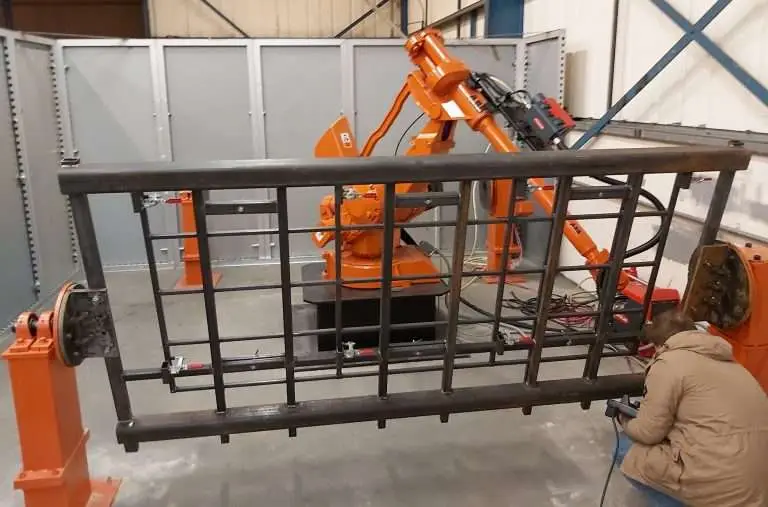
Arc welding robots are a popular and efficient welding method. They use an electric arc to join metals together, providing an effective manufacturing solution for various assembly applications. They also lead to better weld quality and greater precision for complex welding applications. Automated welding systems ensures easier and consistent welding of difficult-to-weld parts. It is an effective manufacturing solution for many assembly applications.
We can find many types of manufacturing applications, but automated cells are popular in car manufacturing for welding the parts and components of the interior and exterior of the automobile in a simpler way.
Moreover, automated welding systems offer significant advantages in terms of productivity, efficiency, quality, safety, and cost-effectiveness, making them an essential component of modern manufacturing processes.
Basic Steps for Automated Arc Welding
- System Setup
- Workpiece Preparation
- Programming
- Arc Starting and Torch Alignment
- Weld Execution
Comparison between Manual Welding Process and Arc Welding Robot Process
Automated welding excels over manual arc welding in automation, precision, productivity, and quality control. Ideal for high-volume manufacturing, it ensures consistent weld quality and efficiency. Manual and automated arc welding differ in automation and control levels. Here’s a comparison:
Automated Arc Welding Process
- Automated Operation: Use industrial robots equipped with torches.
- Precise Control: They offers precise control over welding parameters for consistent quality.
- High Productivity: They is highly efficient, working continuously and at faster speeds than manual welding.
- Reduced Labour Costs: By automating the welding process, automated welding reduces the need for manual labor and increases throughput.
Arc Welding Manual Process
- Manual Operation: In traditional arc welding, the welding process is manually performed by a human operator.
- Operator Skill Required: Arc welding requires skill and experience from the operator to maintain proper welding parameters.
- Variable Quality: The quality of welds in manual arc welding can vary, leading to potential defects.
- Limited Productivity: Manual arc welding is generally less productive than automated processes.
Types of Welding for Automated Manufacturing
Despite these challenges, the benefits of automated systems in welding, including improved efficiency, quality, and safety, often outweigh the drawbacks, making it a popular choice for manufacturers seeking to optimize their welding processes.
Cons of Arc Welding and Robotics
- High upfront cost: These robots can be expensive for smaller businesses.
- Complex implementation: Operators and maintenance personnel may require specialized expertise.
- Regular maintenance: Routine inspections, calibration, and servicing are required for optimal performance and uptime.
- Integration challenges: Compatibility issues, space constraints, and workflow disruptions may arise when integrating the robots.
- Time-consuming programming: Programming can take a long time, resulting in downtime or delays in production.
- Limitations in dexterity: They have limitations in precision and may struggle with complex geometries or difficult-to-reach areas.
Pros of Arc Welding and Robotics
- Efficiency: Robots boost productivity and throughput with zero breaks.
- Precision: These automated systems execute welds with precision and repeatability, improving quality and reducing defects.
- Quality: Welding systems can produce consistent, high-quality welds with minimal variation, improving product reliability.
- Safety: The welding cell systems automate welding, reducing the need for human operators, improving safety, and reducing the risk of accidents.
- Flexibility: They are versatile and adaptable to changes, making them suitable for diverse welding applications.
- Cost Savings: The welding systems require a high investment but provide economic benefits through productivity gains and reduced costs, rework, or scrap.
Pros and Cons of Various Types of Robotic Welding
Various types of welding techniques are utilized in automated manufacturing. Below, you will find the advantages and disadvantages of three of the most frequently used methods:
Laser Welding:
Pros:
- Precision: Controls weld parameters and positioning.
- Minimal Heat: Reduces distortion and heat-affected zones.
- Versatility: Can weld various materials and thicknesses.
- Clean Welds: Minimal post-weld cleanup with less spatter.
Cons:
- High Investment: Expensive to acquire and maintain.
- Limited Access: Challenging access to some joint configurations.
- Safety Concerns: Requires proper eye protection and safety measures.
- Material Sensitivity: Reflective materials may need special considerations.
Spot Welding:
Pros:
- High-speed production: Rapidly joins sheet metal components.
- Minimal heat distortion: Reduces distortion, critical for automotive body construction.
- Consistent weld quality: Provides uniform welds.
- Minimal post-weld cleanup: Produces clean welds without spatter.
Cons:
- Limited joint access: Restricted to overlapping sheet metal parts.
- Fixturing requirements: Requires precise fixture design.
- Equipment maintenance: Spot welding electrodes require regular replacement.
- Limited material thickness: Typically used for thin to medium gauge materials.
MIG/MAG Welding:
Pros:
- Versatility: Can weld various materials including steel, stainless steel, and aluminum.
- High deposition rates: Enables fast welding speeds and high productivity.
- Ease of automation: Continuous wire feed makes it well-suited for robots.
Cons:
- Consumable costs: Consumable wire and gas can add to costs.
- Limited positions: Less suitable for vertical or overhead welding.
- Potential for spatter: May produce spatter, requiring cleaning.
- Dependency on shielding gas: Wind can affect shielding gas coverage.
Customise Robotic Cell System
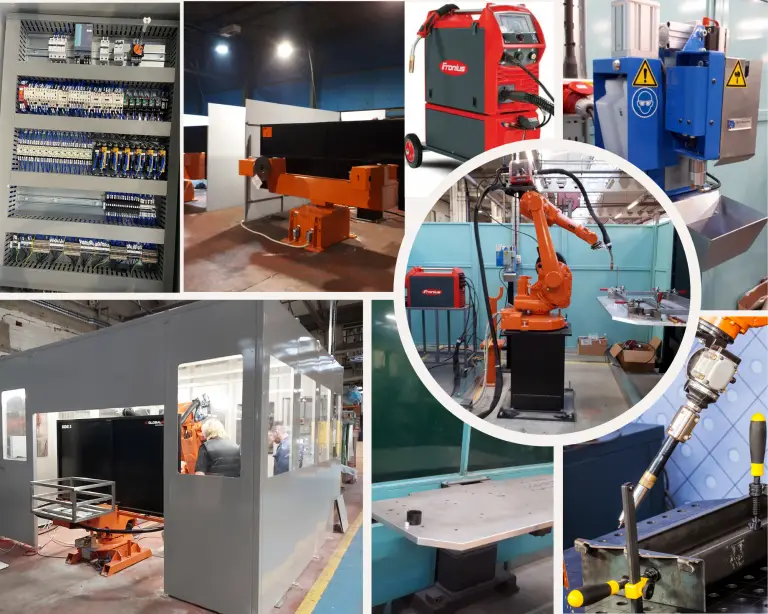
All of our reconditioned robots undergo thorough testing and painting before shipment. We offer new or used robots for any manufacturing application from any major name-brand manufacturers, such as ABB, KUKA, FANUC, and Motoman. If you are in need of robot spares, we can provide those for you as well.
Our company also offers customised arc welding cells, including training, programming, and after-sales support. Our engineers are available to assist you in selecting the ideal robot for your product requirements.
Welding: Global Market for Robotics
According to a new recent report, “The market has witnessed significant growth over the past decade due to the advantages in welding such as durability and robotics technologies. Moreover, an increase in the penetration of IoT and investment in the car industry is expected to drive the growth of the global market.” Contact Robot Store at +44 (0) 07840-913224.